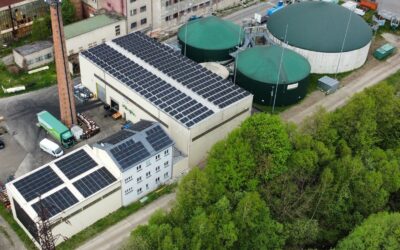
Kitchen waste is still not being sorted properly in Czech towns and villages. At the end of September, during Waste Day in Uherský Brod, the Energy financial group (EFG) presented ways of dealing with this waste so that it does not end up uselessly in landfills. An analysis of waste during the event showed that leftover food and cooked meals still make up a large part of the contents of mixed waste bins. Instead of being sent to landfill, these can be used as a renewable energy source and processed into low-emission biomethane, electricity, and heat. A lot of plastic, paper, textiles, and glass also still end up unnecessarily in containers.
Table of Contents
Although food waste can be sorted into brown bins in Uherský Brod, an analysis of waste carried out on September 24 this year in cooperation with the authorized packaging company EKO-KOM, a.s., showed that up to a third of the contents of so-called black bins for mixed municipal waste still consists of kitchen waste, which then ends up unnecessarily in landfills. With the aim of motivating locals to actively participate in sorting this type of waste, the EFG group also took part in educational activities on Waste Day. It was represented in Uherský Brod through the “Třídím gastro” and EFG Educa projects, which focus on supporting the separate collection of kitchen waste and environmental education.
What did the analysis reveal? Apartment complexes sort better than single-family homes, plastic and paper still end up in black trash cans
During the event, mixed municipal waste was analyzed using a garbage truck, which collected mixed municipal waste, first from housing estates and then from areas with family homes. Both samples were subsequently dumped on the square and analyzed by experts from EKO-KOM, a.s.


Source: Uherský Brod
The analysis revealed an interesting difference between apartment complexes and family housing. In apartment complexes in Uherský Brod, 41.7% of the contents of black bins is waste that could be sorted, while in areas with family homes, it is almost half (49.8%). The better results in apartment complexes may be related, among other things, to the introduction of collection containers for food waste, which are distributed there as part of the “Třídím gastro” (I sort food waste) project. Thanks to the involvement of apartment complex residents in this project, an average of up to 1.3 tons of kitchen waste is collected each month in Uherský Brod.


Source: Uherský Brod
The results of the analysis also showed that, apart from food waste, the contents of black bins in Uherský Brod most often consist of plastics, paper, and glass, which should have ended up in colored containers. There are almost 250 locations for sorted waste in Uherský Brod, so there are more than enough opportunities for proper disposal.
“The waste analysis, which we have made publicly available so that anyone passing by can get an idea of how much room for improvement we still have in terms of waste sorting in the city, showed that almost a third of mixed municipal waste consists of non-compostable organic waste, mainly food scraps and cooked meals. This is a worrying figure, which shows that despite the presence of collection containers in certain areas of the city, we still have room for improvement. It is essential not only to sort waste correctly, but also to prevent its production and reduce unnecessary food waste,” says Luděk Dubrava, municipal waste management specialist for the city of Uherský Brod.
“Sorting food waste is a rational way for cities and municipalities not only to protect the environment, but also to save on fees for landfilling mixed municipal waste. The results of waste analysis and our internal statistics show that both the representatives and residents of Uherský Brod are trying to approach waste management responsibly, but there is certainly still room for improvement. Our goal is to support them in these efforts and to continue to increase the amount of sorted food waste through mutual cooperation,” adds Ondřej Černý, director of the EFG Logistics division, which oversees the project, regarding Uherský Brod’s involvement in the “Třídím gastro” project.
Educational impact of Waste Day
Waste Day attracted not only the general public, but also children and pupils from local schools. Experienced lecturers from the EFG Educa environmental education project explained to them how, where, and why waste is sorted and what is produced from it. They had the opportunity to look at a number of samples of recycled materials and also watch how waste was sampled from trash cans. They could see with their own eyes what should not end up in regular trash cans. At the same time, it was pointed out during the day that properly sorted food waste can still be used. It can be transported to a biogas plant, where instead of being landfilled, it is processed into low-emission biomethane, electricity, and heat. This turns waste into a renewable energy source that contributes to reducing emissions and protecting the environment.
“We are delighted that during Waste Day in Uherský Brod, we were able to explain the principles of proper food waste management to residents and schoolchildren in an interactive way and explain why it is important to separate it from ordinary garden organic waste, such as grass and leaves. We believe that this will result in less food waste ending up in mixed municipal waste,” says Gabriela Lenderová, project manager of EFG Educa’s educational programs, describing the event.