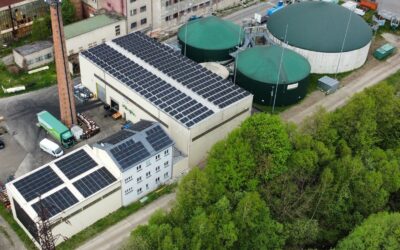
According to a statistical report by the European Biogas Association (EBA), biomethane production in European countries, including the Czech Republic, is undergoing a fundamental transformation. While biogas plants were previously often associated with the use of purpose-grown crops, mainly corn, the current trend is towards so-called advanced biomethane. This is produced mainly from waste materials, both from food waste, for example from households, supermarkets, and industrial plants, and from agricultural residues. Advanced biomethane is thus becoming one of the most effective solutions for the circular economy, while also contributing to the decarbonization of energy and transport.
There has been a clear shift in the composition of input materials for biogas and biomethane production on the European biomethane market. Almost half of European biomethane production already comes from waste sources, mainly kitchen scraps, unsaleable food from industrial plants, and wastewater sludge. Producing biomethane from these inputs not only reduces greenhouse gas emissions, but also solves the problem of waste disposal, which would otherwise end up in landfills.
This shift is linked to the growing emphasis on reducing greenhouse gas emissions and the development of the European legislative framework, in particular the RED III Directive, which favors the use of waste and residual raw materials with high emission savings. This confirms the gradual shift away from primarily grown raw materials and the strengthening of the role of so-called advanced biomethane.
Biomethane produced from easily processed, purpose-grown agricultural feedstocks achieves lower emission savings compared to biomethane produced from biodegradable waste, where more significant emission savings are achieved by shifting this waste away from landfills. This so-called advanced biomethane is therefore more valuable and also represents a local and sustainable alternative to natural gas, which can be supplied to the gas network without restriction or used in transport in the form of BioCNG or BioLNG.
Energy financial group (EFG), the Czech market leader, which currently operates two of the thirteen Czech production plants for this gas, also focuses on the production of advanced biomethane. Both plants process waste.
“The shift towards advanced biomethane production makes sense for several reasons. The amount of emissions savings achieved through the processing of waste materials is important. This is one of the factors that determines the price of biomethane and thus increases the overall value of the produced commodity. At the same time, we are exploiting the full potential of waste that would otherwise end up in landfills. Last but not least, there is growing interest in advanced biomethane on the side of demand. We therefore see the focus on its production as meaningful not only from an environmental perspective, but also from an economic one,” adds Petr Voltr, Director of the EFG Commodities Division.

In the Czech Republic, biomethane is primarily intended for the transport sector
In the Czech Republic, advanced biomethane should find its main application in the transport sector. It meets the strictest European criteria for renewable fuels, making it an important tool for meeting national and European targets for reducing emissions in the transport sector, which is one of the most complicated in terms of decarbonization. This is one of the reasons why documents such as the Action Plan for the Development of Biomethane Production and the National Clean Mobility Plan anticipate that advanced biomethane will be used primarily in this sector.
Especially for freight, urban, and suburban public transport, it is an interesting alternative to fossil fuels, which may be a more effective solution than electrification, where limited range and charging time are an issue. Biomethane in the form of BioCNG and BioLNG can be used without any problems in the existing infrastructure of publicly accessible filling stations, of which there are already 245 in the Czech Republic (according to the records of the Ministry of Industry and Trade of the Czech Republic). Compared to diesel or gasoline, biomethane from waste materials produces significantly lower emissions of particulate matter, nitrogen oxides, and carbon dioxide. Vehicles running on biomethane are also quieter than those with traditional diesel engines, offering greater comfort for passengers. As a result, biomethane in transport has a very high environmental benefit for cities and the climate.